
The US Data Privacy Compliance Checklist: What Every Business Needs to Know
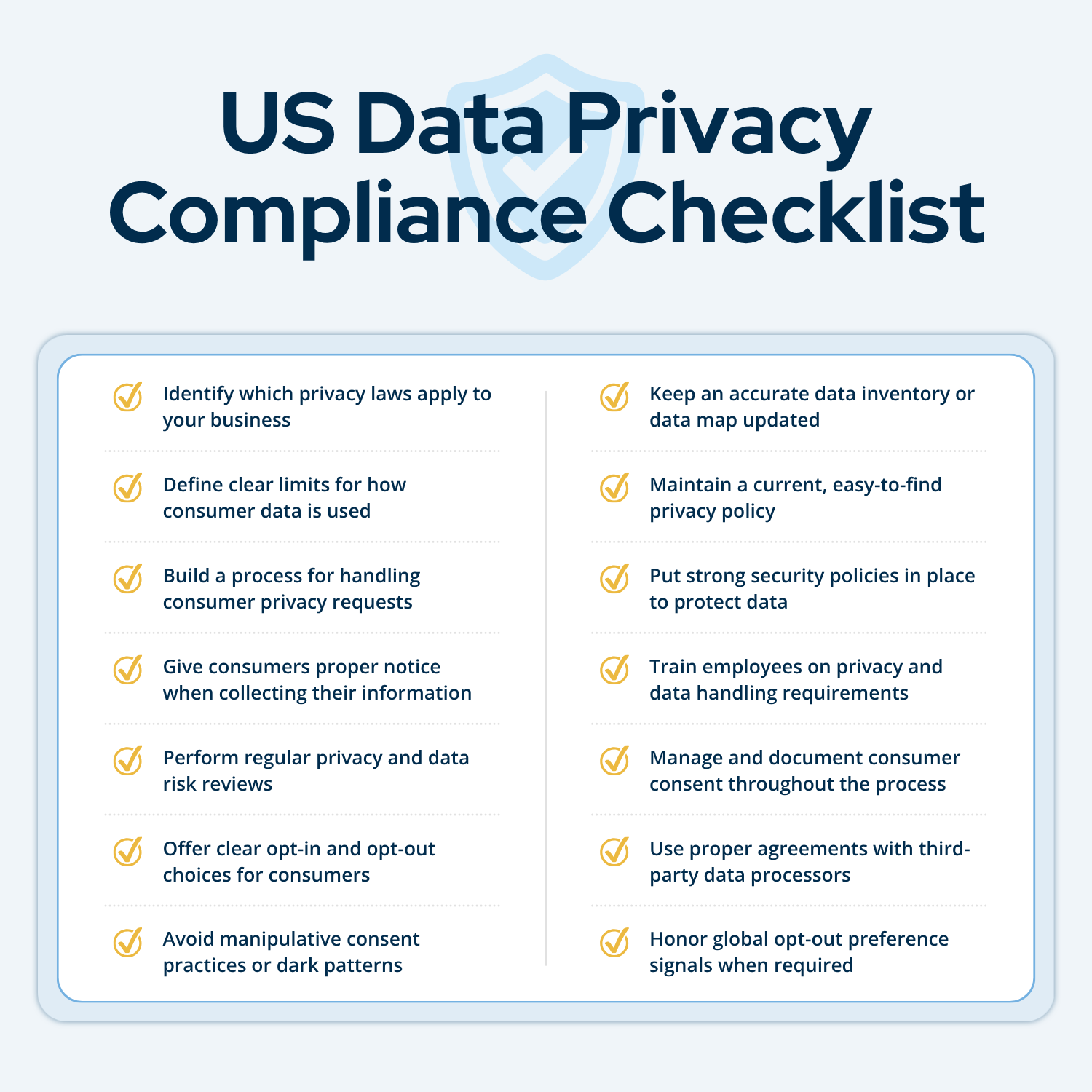
Summary: US state privacy laws are multiplying and enforcement is increasing, but compliance is manageable with the right processes. This article walks through all 14 items on the US Data Privacy Compliance Checklist. The items are grouped into four areas: knowing your obligations, building processes, staying transparent with consumers, and protecting data.
Data privacy is no longer a concern reserved for legal teams and enterprise IT departments. For businesses of every size — from SaaS platforms to franchise brands — it has become a front-line operational priority. US state privacy laws are multiplying, enforcement is increasing, and consumers are paying closer attention to how their data is collected and used.
The good news: compliance is manageable when you build the right processes. This article walks through all 14 items on the US Data Privacy Compliance Checklist, explaining not just what to do, but why each step protects your business and your customers.
Know Your Obligations
Before you can comply with data privacy law, you need to know which laws apply to you.
1. Identify Which Privacy Laws Apply to Your Business
The US privacy landscape is a patchwork of state laws. The California Consumer Privacy Act (CCPA) and its successor, the CPRA, are the most well-known. But Virginia's Consumer Data Protection Act (CDPA), Colorado's CPA, Connecticut's CTDPA, and a growing list of additional state laws each carry their own requirements and thresholds. Knowing which laws govern your business — based on where your customers live, not where your office is — is the essential first step.
2. Define Clear Limits for How Consumer Data Is Used
Purpose limitation is a core principle in most privacy frameworks. If you collect an email address for a newsletter, using it to build ad targeting profiles without disclosure is a violation waiting to happen. Define internally what data you collect, why, and what the boundaries are. This protects you legally and builds internal discipline around data use.
3. Keep an Accurate Data Inventory or Data Map Updated
You cannot protect data you cannot find. A data inventory — sometimes called a data map — documents what personal data you collect, where it lives, how it flows through your systems, and who has access to it. This is foundational for almost every other compliance activity on this list.
Build the Right Processes
Having a privacy policy is not enough. Compliance lives in your day-to-day operations.
4. Build a Process for Handling Consumer Privacy Requests
Under CCPA and similar laws, consumers have the right to know what data you hold, request its deletion, and, in some cases, correct it or restrict its use. You need a documented, repeatable process to receive and respond to these requests within the legally required timeframes — typically 45 days.
5. Perform Regular Privacy and Data Risk Reviews
Privacy risks evolve as your business grows, as you adopt new tools, and as laws change. Periodic reviews — sometimes called privacy impact assessments or data protection assessments — help you catch gaps before they become liabilities. Think of it as a compliance audit built into your business calendar.
6. Manage and Document Consumer Consent Throughout the Process
It is not enough to obtain consent once. You need to record when consent was given, what it covered, and whether it was later withdrawn. This documentation is your evidence of compliance if a regulator or consumer ever challenges you.
7. Use Proper Agreements with Third-Party Data Processors
If you share consumer data with vendors, agencies, or software platforms, you are responsible for how they handle it. Data processing agreements (DPAs) establish that your vendors are contractually bound to the same data protection standards you follow. Without them, your vendor's lapse becomes your liability.
Stay Transparent with Consumers
Transparency is not just a legal requirement — it is a competitive differentiator.
8. Give Consumers Proper Notice When Collecting Their Information
At the point of collection — a form, a checkout page, a mobile app — consumers should understand what data you are gathering and why. Clear, plain-language notices build trust and reduce the risk of complaints.
9. Maintain a Current, Easy-to-Find Privacy Policy
Your privacy policy must accurately reflect your current data practices. An outdated policy is not just a credibility problem — it is a compliance risk. Review it whenever you change how you collect or use data, and make sure it is accessible from every page of your website.
10. Offer Clear Opt-In and Opt-Out Choices for Consumers
Consent must be meaningful. Consumers should be able to opt in to data uses that go beyond the core service — and opt out just as easily. A buried, difficult-to-use opt-out mechanism is not compliant, and regulators have made clear they are looking for it.
11. Avoid Manipulative Consent Practices or Dark Patterns
Dark patterns — design choices that trick users into agreeing to data collection they would not otherwise accept — are explicitly addressed in CCPA/CPRA regulations and in FTC guidance. This includes pre-checked boxes, confusing toggle language, and "confirm shaming." Avoid them entirely.
12. Honor Global Opt-Out Preference Signals When Required
California law requires businesses to honor opt-out preference signals from recognized browser-based tools such as the Global Privacy Control (GPC). If you operate in California and sell or share personal data, this is a technical requirement, not just a best practice.
Protect Your Data
Compliance is not only about rights and notices — it is about security.
13. Put Strong Security Policies in Place to Protect Data
Most US state privacy laws require reasonable security measures to protect personal data. This means documented policies, access controls, encryption where appropriate, and incident response plans. A data breach without adequate security in place will compound your legal exposure.
14. Train Employees on Privacy and Data Handling Requirements
Your technology and policies are only as strong as the people following them. Regular employee training — covering what data they handle, how to handle it, and what to do if something goes wrong — closes the human gap in your compliance program.
The Business Case for Compliance
Data privacy compliance is not just about avoiding fines, though those can be significant — CCPA violations can reach $7,500 per intentional violation. The real competitive advantage is trust.
Consumers increasingly choose brands that demonstrate responsible data practices. In a franchise or SaaS context, where your customers are often entrusting you with their customers' data, privacy compliance is a sales asset. It shortens vendor security reviews, satisfies enterprise procurement requirements, and differentiates you in crowded markets.
Businesses that build privacy into their operations now — rather than retrofitting it after a complaint or enforcement action — spend less and stress less. Compliance is far cheaper than remediation.
Take the First Step Today
Data privacy compliance can feel overwhelming, but with this checklist, it is manageable. Start by identifying which laws apply to your business, audit what data you currently hold, and build your processes from there.
Use this checklist as your roadmap. Check off each item, document your work, and revisit it regularly. The businesses that treat privacy as an ongoing discipline — not a one-time project — are the ones best positioned for what comes next.
